
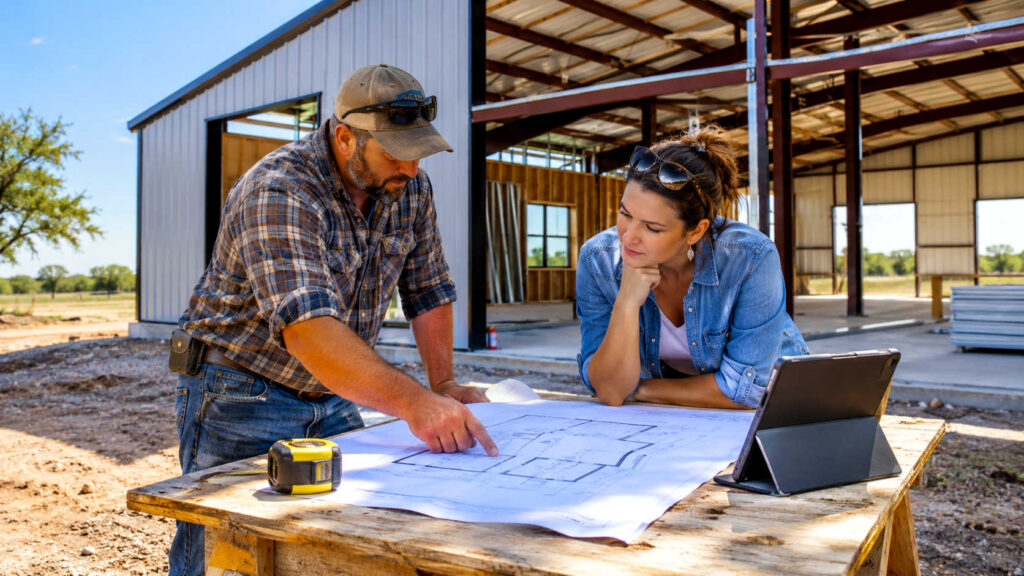
Building a barndominium is an opportunity to create a home that reflects the way you want to live. Whether your vision includes a spacious country retreat, a modern residence with an attached workshop, or a practical family home surrounded by open land, the possibilities are exciting. However, bringing that vision to life involves more than selecting a floor plan and choosing attractive finishes. One of the most important decisions you will make is choosing the right builder. The contractor you hire will influence everything from construction quality and project costs to scheduling, communication, and your overall experience. A knowledgeable, dependable builder can help turn a complicated process into a rewarding one. An inexperienced or poorly organized contractor, on the other hand, can create expensive problems that extend well beyond move-in day. Before signing a construction contract, taking the time to ask the right questions can make all the difference.
Barndominiums also present construction considerations that distinguish them from traditional homes. Many feature engineered steel framing, expansive interior spaces, large exterior openings, and combinations of residential, recreational, and workshop areas. These elements require careful coordination between structural design, insulation, ventilation, mechanical systems, and interior construction. A contractor experienced in building metal agricultural structures may not necessarily possess the expertise needed to complete a comfortable residential home. Likewise, a conventional homebuilder may be unfamiliar with certain barndominium construction methods. Finding a professional who understands both sides of the process is essential. At Barndominiums in Texas, we believe homeowners should enter the construction process with realistic expectations and the knowledge needed to make informed decisions. The following questions will help you evaluate prospective builders, understand their proposals, and identify potential concerns before committing to a construction agreement.
1. How Much Experience Do You Have Building Residential Barndominiums?
Experience with conventional residential construction does not automatically translate into experience building barndominiums.
Ask prospective contractors how many residential barndominiums they have completed and whether they have constructed homes similar in size, design, and complexity to yours.
A contractor familiar with steel workshops may understand structural assembly but have limited experience integrating residential plumbing, electrical systems, insulation, interior finishes, and climate control.
Request photographs of completed projects and ask about construction challenges the builder has encountered.
A qualified contractor should be comfortable explaining the methods used on previous projects and how that experience applies to your proposed home.
2. Can You Provide References From Previous Homeowners?
Photographs and testimonials can provide a favorable impression of a builder’s work, but conversations with previous customers offer a more complete picture.
Request references from several homeowners whose projects were completed within the past few years.
Ask whether construction stayed reasonably close to the original budget and schedule, how unexpected expenses were handled, and whether communication remained consistent throughout the project.
You should also ask how the builder addressed problems after construction was completed.
If possible, arrange to visit a finished barndominium with the owner’s permission. Examining the workmanship firsthand may reveal details that are difficult to evaluate through photographs alone.
3. Are You Properly Insured, and What Qualifications Do You Hold?
Before signing an agreement, verify that the builder carries appropriate insurance and meets applicable professional requirements.
Texas does not require a universal statewide license for residential general contractors. However, certain specialized trades, including electrical, plumbing, and HVAC work, have separate licensing requirements. Some municipalities also require contractor registration or impose additional local requirements.
Ask about general liability insurance, workers’ compensation coverage, and how subcontractor insurance is handled.
Request documentation and verify coverage when appropriate.
It is equally important to determine whether licensed professionals will perform work that requires specialized credentials.
A reputable builder should be willing to explain these qualifications without hesitation.
4. What Construction Method Do You Recommend for My Home?
Barndominiums can be constructed using engineered steel framing, post-frame construction, conventional wood framing, or combinations of these methods.
Each approach offers different advantages depending on the home’s layout, intended use, and location.
Ask the builder which structural system they recommend and why.
Discuss how the proposed design accommodates ceiling heights, open spans, large windows, overhead doors, and future modifications.
The builder should also explain how structural loads and local weather conditions influence the design.
In Texas, wind exposure and soil conditions can significantly affect construction requirements.
A knowledgeable contractor will recognize when engineering expertise is necessary and explain how those professionals will contribute to the project.
5. Who Will Handle Plans, Engineering, and Permits?
Before construction begins, determine who will be responsible for preparing plans, obtaining engineering documents, and securing required approvals.
Some contractors provide design-build services, coordinating design and construction under one agreement. Others require homeowners to supply completed plans before work begins.
Ask who will prepare structural drawings, foundation specifications, and other necessary documents.
You should also clarify who will submit permit applications, arrange inspections, and address required corrections.
Regulations vary considerably throughout Texas.
Properties located within city limits may face different requirements than rural properties in unincorporated areas. However, rural construction can still be subject to septic, floodplain, utility, and other development requirements.
Never assume that building outside city limits eliminates the need for permits or inspections.
6. What Exactly Is Included in the Construction Estimate?
Two construction proposals may appear similar in price while covering very different amounts of work.
One contractor may provide a complete, move-in-ready home. Another may quote only the foundation, structural shell, and exterior components.
Request a detailed written scope of work identifying what the estimate includes.
Pay particular attention to site preparation, foundation work, framing, roofing, insulation, windows, doors, utilities, mechanical systems, and interior finishes.
Ask whether landscaping, driveways, septic systems, and utility connections are included or priced separately.
You should also understand how allowances work.
For example, a contract may include a specific allowance for cabinetry or flooring. If your selections exceed that amount, the difference may increase the final construction cost.
At Barndominiums in Texas, we encourage homeowners to evaluate estimates based on their complete scope rather than comparing prices alone.
7. Is This a Fixed-Price or Cost-Plus Contract?
Understanding the contract’s pricing structure is essential to controlling expenses.
A fixed-price agreement generally establishes a predetermined amount for a defined scope of construction, subject to approved changes and other contract provisions.
A cost-plus arrangement typically requires the homeowner to pay actual construction expenses along with an agreed builder fee or markup.
Both approaches can work, but they allocate financial responsibilities differently.
Ask how material costs, labor expenses, subcontractor charges, and builder fees will be documented.
If the contract is cost-plus, determine whether there is a guaranteed maximum price or another agreed spending limit.
Regardless of the arrangement, make sure you understand what circumstances could increase the amount you ultimately pay.
8. How Are Changes and Unexpected Costs Handled?
Changes are common during residential construction.
You may decide to upgrade flooring, add windows, relocate a doorway, or modify the workshop area after construction begins.
Unexpected ground conditions or material availability can also require adjustments.
Ask the builder how these situations are addressed.
A clear change-order process should explain how modifications are requested, priced, approved, and documented.
Each change should identify its financial impact and any anticipated effect on the construction schedule.
Avoid relying on verbal agreements for significant modifications.
Written change orders establish a record of what was approved and help prevent disagreements later.
9. How Will You Evaluate and Prepare My Property?
The condition of your land can substantially influence construction costs and long-term building performance.
Before committing to a contractor, discuss how the property will be evaluated.
Important considerations include soil conditions, drainage, elevation, accessibility, and utility availability.
Some Texas properties contain expansive clay soils that can affect foundation design. Others may present drainage challenges, uneven terrain, or limited access for construction equipment.
Ask whether soil testing or a geotechnical evaluation is recommended and who will coordinate any required foundation engineering.
Also determine whether the estimate covers excavation, grading, driveway preparation, and utility trenching.
These site-related expenses can represent a meaningful portion of the overall budget.
Identifying potential challenges early provides an opportunity to address them before construction begins.
10. What Is Your Approach to Insulation and Moisture Control?
Insulation and moisture management deserve particular attention in barndominium construction.
Metal building assemblies can experience condensation problems when insulation, air sealing, ventilation, and temperature control are not properly coordinated.
Ask what insulation materials the builder recommends and how the proposed design addresses thermal bridging, air leakage, and moisture accumulation.
The insulation strategy should complement the wall and roof assemblies rather than being selected as an isolated product.
Discuss how the HVAC system will be sized and how indoor humidity will be controlled.
Texas encompasses a wide range of climate conditions, and a building approach suitable for one region may require modifications in another.
A properly designed system contributes to comfort, energy efficiency, and the long-term condition of the home.
11. Who Will Supervise Construction and Manage Subcontractors?
The individual who prepares your estimate may not be the person overseeing construction.
Ask who will serve as the project manager and how frequently that person will be present at the job site.
Determine whether the builder relies primarily on employees, independent subcontractors, or a combination of both.
You should understand who schedules the trades, coordinates their work, reviews workmanship, and addresses construction problems.
Consistent supervision is especially important when structural, mechanical, and residential systems must be integrated.
Clear responsibilities reduce confusion and make it easier to resolve concerns as they arise.
12. What Is the Expected Construction Timeline?
A realistic construction schedule should account for more than the time required to erect the building’s frame.
Ask for an estimated timeline identifying major stages such as site preparation, foundation work, framing, exterior construction, mechanical installations, insulation, interior finishing, inspections, and final completion.
Discuss potential delays related to weather, material deliveries, subcontractor availability, and changes requested during construction.
It is also important to understand how scheduling updates will be communicated.
Ask whether the contract establishes a projected completion date and what provisions apply if the schedule changes.
Be cautious of unusually aggressive timelines that lack a clear explanation of how the work will be completed.
13. How Will Payments Be Scheduled and Verified?
Construction contracts commonly require payments at established milestones.
Before signing, determine how much money is required upfront and when subsequent payments become due.
Ideally, the payment structure should correspond to clearly identifiable construction progress.
If you are using a construction loan, confirm that the builder’s schedule aligns with your lender’s draw and inspection requirements.
Ask how invoices will be documented and whether appropriate lien waivers or releases will be provided.
Texas law includes specific requirements involving construction payments, lien claims, and protections for residential property owners.
Depending on the circumstances, unpaid subcontractors or suppliers may have legal remedies involving the property, even when the homeowner has already paid the general contractor.
Because these rules can be complex, consider having a qualified Texas construction attorney review the payment provisions before signing.
14. What Warranties and Post-Construction Support Do You Provide?
A builder’s commitment to quality should extend beyond the day construction is completed.
Ask what warranties cover workmanship, structural components, roofing, mechanical installations, and other major systems.
Some products may include separate manufacturer warranties, while other coverage may come directly from the builder.
Request written copies of the applicable warranty terms.
Find out how defects or performance concerns are reported, how warranty claims are evaluated, and what response procedures are provided.
You should also ask whether the builder conducts a final walkthrough and provides a process for documenting unfinished or unsatisfactory work.
A clear approach to post-construction support can make a substantial difference in your experience as a homeowner.
15. How Will Disputes or Contract Problems Be Resolved?
Even projects that begin with excellent communication can encounter disagreements.
Before signing, review the contract’s provisions for dispute resolution, termination, delays, defective work, and unpaid balances.
Determine whether disagreements must be addressed through mediation, arbitration, or litigation.
Pay attention to any provisions that affect your ability to pursue legal remedies or recover costs.
Ask how disputes involving workmanship, unexpected charges, or schedule changes will be documented and handled.
Because construction agreements can contain complicated legal terms, having an attorney familiar with Texas residential construction review the contract is a worthwhile precaution.
The purpose is not to anticipate conflict but to ensure both parties understand their responsibilities if something goes wrong.
Recognizing Warning Signs Before Hiring a Builder
Most homeowners want to establish a positive working relationship with their contractor. However, certain behaviors deserve additional scrutiny.
Be cautious if a prospective builder:
- Refuses to provide a detailed written estimate or scope of work.
- Cannot supply references from completed residential projects.
- Pressures you to sign before thoroughly reviewing the agreement.
- Requests unusually large upfront payments without a reasonable explanation.
- Avoids questions about insurance, engineering, permits, or subcontractors.
- Makes important verbal promises that are missing from the contract.
- Provides a dramatically lower estimate without explaining the difference.
- Cannot identify who will supervise construction.
- Dismisses concerns about foundations, drainage, insulation, or moisture control.
- Offers unclear warranty terms or avoids discussing post-construction responsibilities.
None of these concerns should be ignored simply because the contractor offers an attractive price or promises an accelerated completion date.
A dependable builder should welcome reasonable questions and provide straightforward answers.
Why the Lowest Bid May Not Be the Best Value
Construction costs are an important consideration for nearly every homeowner.
However, selecting the lowest-priced contractor without examining the proposal can create financial problems later.
A less expensive estimate may exclude essential work, rely on lower allowances, or omit site preparation costs that another builder has already included.
The result may be additional expenses that were not apparent during the initial comparison.
When evaluating proposals, consider the builder’s experience, materials, workmanship, communication practices, and overall project management approach.
Ask questions about differences between estimates and request clarification when one proposal appears substantially less expensive than the others.
The best value is not necessarily the lowest initial price. It is the combination of quality, transparency, reliability, and long-term performance.
For homeowners researching construction approaches and design possibilities, Barndominiums in Texas provides practical information to help make these comparisons more meaningful.
Review the Complete Contract Before Signing
Once you have selected a builder, resist the temptation to treat the construction agreement as a formality.
The contract establishes the responsibilities and expectations that will guide the project from beginning to completion.
Make sure the written agreement accurately reflects the approved plans, construction specifications, agreed price, payment schedule, estimated timeline, and change-order procedures.
It should also identify important exclusions, warranty provisions, insurance responsibilities, and procedures for resolving disputes.
Texas residential construction law includes certain disclosure and documentation requirements that may apply to your agreement. Confirm that the contract addresses applicable legal requirements.
If a promise was important enough to influence your decision to hire the builder, it should be reflected in the written documents.
Take the time to review everything carefully and seek professional guidance when necessary.
A well-prepared contract does more than protect the parties involved. It creates a shared understanding of what constitutes a successful project.
Build With Confidence by Choosing the Right Partner
Hiring a barndominium builder is about much more than finding someone who can construct an attractive building. It involves selecting a professional who understands your goals, communicates clearly, manages construction responsibly, and recognizes the importance of your investment.
The questions you ask before signing a construction contract can help you distinguish between contractors who simply offer construction services and those who are prepared to guide you through the complexities of creating a residential barndominium.
Thorough research, careful comparisons, and clearly documented expectations can reduce uncertainty and help prevent costly misunderstandings.
While it may be tempting to begin construction as quickly as possible, the time invested in choosing the right builder can contribute to a smoother experience and a more satisfying finished home.
Barndominiums in Texas is committed to helping homeowners navigate the possibilities of barndominium living through thoughtful design ideas, practical construction guidance, and informative resources. Whether you are researching building methods, comparing floor plans, or preparing to meet with prospective contractors, understanding the process can help you make decisions with greater confidence. A successful barndominium begins long before the foundation is poured. It begins with informed decisions, realistic expectations, and a trusted builder who understands how to turn your plans into a home, so give us a call at 833-886-6355 or fill out our contact form and we’ll discuss the perfect barndominium for you.